

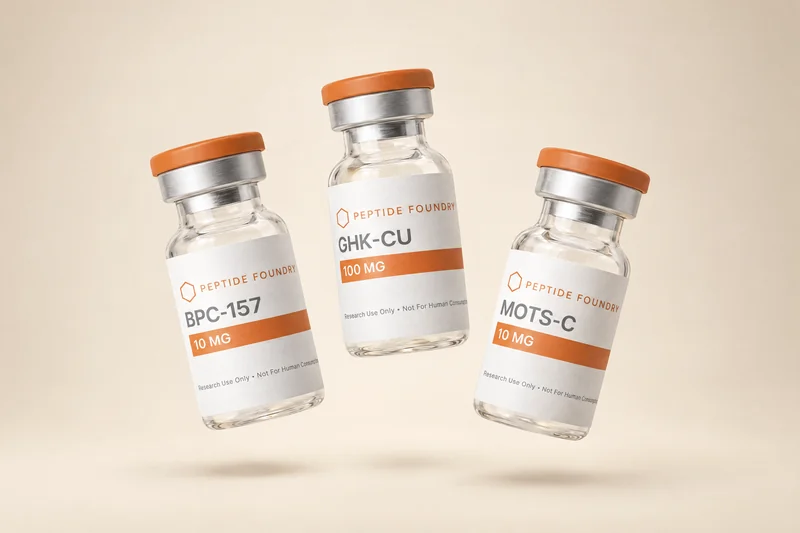
CJC-1295 + Ipamorelin is a two-peptide co-lyophilized research blend. This page covers DAC vs no-DAC identity (why formula/MW matter), Peptide Foundry’s published component anchors and mass options, and why blend COAs need per-component HPLC/MS. Research use only.
CJC-1295 + Ipamorelin is a market label for a co-lyophilized two-peptide research blend, not a single CAS-registered molecule. Buyers comparing “cjc ipamorelin research peptide,” “high purity cjc ipamorelin,” or “cjc ipamorelin with coa” listings usually need two things first: which CJC-1295 chemical identity the seller means (with DAC versus no-DAC / Mod GRF naming), and whether the certificate documents both peptides as separate analytes.
This page covers Peptide Foundry’s published component anchors and size options, DAC identity literacy via formula and molar mass, why blend COAs need per-component HPLC and mass spectrometry, vendor red flags common on this cluster, and a soft handoff to the gated CJC-1295 + Ipamorelin research product page. Research use only.
Key points
- Market name for a two-component blend, not a single CAS substance.
- DAC vs no-DAC is a chemical-identity question — CAS 863288-34-0 alone does not settle it; read formula and molar mass.
- Peptide Foundry labeled sizes: 5mg/5mg and 10mg/10mg (1:1 by mass, not molar).
- Blend certificates should support both components (HPLC + identity/MS; ideally per-component net content) — a lone “blend purity %” is incomplete.
- Research use only — not for human or veterinary use.
What is the CJC-1295 + Ipamorelin research blend?
It is a co-lyophilized research reagent that combines two separately registered peptides in one lyophilized cake: a synthetic GHRH-receptor analog from the CJC-1295 naming family, and Ipamorelin, a selective synthetic pentapeptide GHS-R1a / ghrelin-receptor agonist as those chemical classes appear in published preclinical literature. That is mechanism-class and research-history language — not a product claim for a market stack, and not a reason to treat the listing name as a registry entry for the blend as a unit.
Historical context for the CJC-1295 line includes long-acting GHRH-analog research constructs associated with ConjuChem / related development history; Ipamorelin appears in literature as a selective ghrelin-receptor agonist class molecule. Those origin notes help inventory and literature search — they do not convert a co-lyophilized catalogue vial into a standardized single substance.
No naming authority registers “CJC-1295 + Ipamorelin” as one molecule. Each listing resolves as vendor shorthand for a two-peptide preparation whose identity lives in the component CAS numbers, formulas and molar masses, labeled milligrams, and lot certificate. Two vendors can sell “CJC + Ipamorelin” with different DAC wording or documentation depth under the same storefront phrase. Compare chemistry blocks and certificates — not the rhyme.
DAC vs no-DAC: identity literacy (not a protocol)
On research-vendor labels, “CJC-1295” is routinely used for more than one molecular convention. The practical question is chemical identity: which construct do the chemistry table and certificate describe?
What “DAC” refers to chemically
DAC means Drug Affinity Complex — an albumin-binding modification historically associated with long-acting CJC-1295 research constructs. No DAC, Mod GRF (1-29), or Modified GRF (1-29) refers to related short-scaffold GHRH(1-29) analog naming used widely on research-vendor labels and certificates. Teach this as labeling and molecular-identity literacy for reagent selection. It is not a personal schedule comparison and not a ranking of “which construct is better” for any end use outside laboratory documentation.
Why CAS alone is not enough
Market listings often cite the same CAS number for both naming conventions. Peptide Foundry’s catalog open-question note is explicit: CAS does not disambiguate; formula and molar mass do. Use the literacy table below as a reading aid — not as a claim that every vendor publishes these numbers correctly.
| Label market uses | Typical formula / MW convention (research-vendor literacy) | Notes |
|---|---|---|
| CJC-1295 with DAC | C165H271N47O46 · ~3647.28 g/mol | Matches Peptide Foundry’s live blend chemistry table / with-DAC convention |
| CJC-1295 no DAC / Mod GRF (1-29) | C152H252N44O42 · ~3367.9 g/mol | Common alternate convention; not what Peptide Foundry’s live formula/MW currently publish |
| Shared CAS often cited | 863288-34-0 | CAS alone is insufficient; read formula, molar mass, and any explicit DAC / no-DAC string on the certificate |
Peptide Foundry’s live blend chemistry table publishes the with-DAC formula and molar mass (C165H271N47O46 / 3647.28 g/mol). Live product-page body copy does not always print the words “with DAC” or “no DAC” in the first screen. Buyers should therefore read the formula and molar mass on the chemistry block and the lot certificate, not the marketing acronym alone. A factual category contrast — not a smear — is that some vendor certificates explicitly print identity strings such as “CJC-1295 no DAC” on the certificate line (for example Freedom Diagnostics language on public Oath Research batch PDFs). That kind of explicit identity string is what buyers should look for when DAC status is material to the assay.
Ipamorelin identity anchors
Ipamorelin is a separately registered research peptide. Peptide Foundry’s live blend table publishes the following anchors (confirm against the current product page if a lot or chemistry block rotates after publish):
| Field | Peptide Foundry live value |
|---|---|
| CAS | 170851-70-4 |
| Formula | C38H49N9O5 |
| Molar mass | 711.85 g/mol |
Optional inventory note: Peptide Foundry’s live gated listing for this blend is CJC-1295 + Ipamorelin. Do not treat a different SKU’s certificate as proof of this blend’s stoichiometry.
Peptide Foundry catalog composition
The tables below match Peptide Foundry’s live gated product panel at the time of writing: SKU PF-CJC-1295-IPAMORELIN, size options 5mg/5mg and 10mg/10mg. Confirm against the current product page if a size attribute or lot panel rotates after publish.
Size and mass-ratio options
| Size option (live PDP) | CJC-1295 labeled mass | Ipamorelin labeled mass | Labeled total |
|---|---|---|---|
5mg/5mg |
5 mg | 5 mg | 10 mg |
10mg/10mg |
10 mg | 10 mg | 20 mg |
The mass ratio is 1:1 by labeled milligrams, not a molar 1:1. CJC-1295 (~3647.28 g/mol) and Ipamorelin (711.85 g/mol) differ by roughly fivefold in molar mass, so equal milligram amounts are not equal molar amounts. For assay math, convert with the molar masses in the identity table rather than treating the milligram label as stoichiometric.
Full component identity table
| Component | CAS# | Formula | Molar mass | PF convention note |
|---|---|---|---|---|
| CJC-1295 | 863288-34-0 | C165H271N47O46 | 3647.28 g/mol | Live table matches with-DAC formula/MW convention |
| Ipamorelin | 170851-70-4 | C38H49N9O5 | 711.85 g/mol | Live PDP chemistry table |
Match formula + mass + lot COA, not the nickname alone. Mass order on a size string (5mg/5mg or 10mg/10mg) should map to the named components on the certificate; if a certificate title lists components in a different sequence, read the masses next to the named components rather than assuming left-to-right label order equals left-to-right certificate order.
Why blend COAs need per-component HPLC and MS
A co-lyophilized vial contains two analytes. Identity, purity attribution, and net content are harder to defend when documentation collapses both peptides into one marketing percentage. For the full verification workflow — batch match, named lab, HPLC versus identity, biosafety panels, portal codes — see How to read a research-peptide COA.
One purity % is not two identities
HPLC purity estimates what fraction of UV-absorbing material is the main peak (or peaks) under the stated method and wavelength. Mass spectrometry checks whether measured mass matches expected identity. Those are orthogonal questions. A single area-% purity without component attribution does not prove both sequences are present at the labeled masses.
Minimum fields a research buyer should demand for this blend:
- A lot / batch ID that matches the vial character for character
- Test date(s) and a named laboratory
- HPLC purity with method and wavelength (for example 214 nm)
- An identity method that can support both components (MS / LC-MS preferred for blends; HPLC-RTM when that is what the lab reports)
- Net peptide content versus labeled mass when reported — ideally as per-component lines
“Third-party tested” or “high purity blend” without a named lab, a lot number, and component-aware identity language is an unfinished claim. Prefer certificates that report per-component identity and, when available, per-component net content (separate milligram lines for CJC-1295 and Ipamorelin).
Category documentation example (factual, no smear)
Oath Research publishes HTML batch lab-results pages for CJC-1295/Ipamorelin with Freedom Diagnostics accession, HPLC-UV purity, LC-MS identity, and split net peptide content (separate milligram lines for Ipamorelin and CJC-1295 on public batch pages). Some of those certificates also print explicit “no DAC” identity language on the certificate line. Cite that pattern as category literacy: it is what strong blend documentation can look like when a laboratory reports each component. It is not a rank, grade, smear, or quality scorecard against any other seller — including Peptide Foundry.
Other category names on this SERP include Peptide Catalog, AminoCore, Apex Labs, IronPeak, American Peptides, Simple Peptides, and Orbitrex. Treat them as a map of documentation styles, not a ranked list. Apply one checklist to every supplier.
Worked Peptide Foundry example — lot FO309
As published on the live Peptide Foundry CJC-1295 + Ipamorelin listing at the time of writing:
| Field | Value |
|---|---|
| Lot | FO309 |
| Panel / size | 10mg/10mg |
| Laboratory | ILS Laboratories (ISO/IEC 17025 narrative on live PDP copy) |
| Received / tested | 16 Jul 2026 / 19 Jul 2026 |
| Purity | 99.12% (HPLC @ 214 nm) |
| Identity | HPLC-RTM — Pass |
| Net peptide content | 20.79 mg (single total on the published panel) |
| Heavy metals | All Pass |
| Sterility | No Growth (PCR) |
| Endotoxin | NMT 0.05 EU/mL |
| Fentanyl screen | Not Detected |
| Access code | UJ9AVS5F |
Honesty about what this panel publishes: FO309 reports a single HPLC purity percentage and a single net-content total (20.79 mg against a 20 mg labeled sum for the 10mg/10mg size). Do not invent per-component milligram splits Peptide Foundry has not published. Stronger blend certificates can still add per-component net content and MS / LC-MS identity that attributes both sequences. Portal-verify the published record either way.
Four steps that travel with any lot, not just FO309:
- Match the lot number on the vial to the lot on the certificate.
- Confirm both component names, the labeled size string, and the chemistry anchors (CAS / formula / molar mass) against the certificate and the product label.
- Read the method lines — HPLC wavelength, identity method, net content, and any full QC panels claimed.
- Verify the access code on the issuing laboratory’s own portal when one is provided — not only by opening a PDF hosted by the supplier.
A PDF on a supplier site is a document the supplier controls. A record you can pull from the testing laboratory is not. When evaluating any supplier in this category, independent verification is the question worth asking.
Vendor red flags for CJC + Ipamorelin listings
Apply the same evidence checklist used across Peptide Foundry’s public research library. For the full USA RUO vendor framework — identity disclosure, lot COA, independent verify, manufacturing claims, shipping, RUO policy, and traceability — see USA research peptide vendor criteria. The table below focuses on failure modes that show up often on this blend cluster.
| Red flag | Why it matters for this blend |
|---|---|
| “CJC-1295” with no DAC / no-DAC / Mod GRF wording and no formula/MW | Identity ambiguous — CAS alone is insufficient |
| Unnamed “US third-party lab” | Unfinished claim; cannot weight the evidence |
| Reused or lot-mismatched COA | Fails batch match; certificate does not describe the vial in hand |
| Single “blend purity %” only; no component list | Two peptides undocumented as two analytes |
| Exactly 100.00% purity with no chromatogram / wavelength | Incomplete method disclosure |
| Human schedule charts, “stack,” or personal-use framing on the research SKU page | RUO break — wrong category for a research reagent listing |
| Compounding-pharmacy or clinic framing for RUO vials | Different regulatory story; not this research page |
Category names are a map, not a substitute for reading the certificate attached to the lot you would receive. Prefer named laboratories, stated wavelengths, identity methods that support both components, and portal access when available.
Storage and lab handling (lyophilized)
Standard laboratory practice for lyophilized synthetic peptides applies to two-component co-lyophilized vials:
- Storage. Sealed vials at −20°C, protected from light and moisture. Lyophilized material is substantially more stable than solution.
- Temperature excursions. Brief ambient exposure in transit is normal for lyophilized material. Return vials to −20°C on arrival.
- Freeze–thaw. Minimize repeated freeze–thaw. Storage stability and handling frequency are separate facts on a certificate for a reason.
- Traceability. Keep the lot number with the material. Lot number is what ties a vial back to its certificate; material separated from its lot number cannot be traced to any analysis.
Specifics beyond lyophilized storage depend on your assay and institution SOPs, which take precedence over supplier guidance. This page does not publish preparation math or personal-use schedules.
Common questions
Is CJC-1295 + Ipamorelin one molecule?
No. It is a market label for a co-lyophilized two-peptide research blend. Identity is the component CAS numbers, formulas, molar masses, and the labeled milligrams of each peptide in the vial — not a single blend CAS.
Does CAS 863288-34-0 tell me DAC vs no-DAC?
Not by itself. The same CAS is often cited across with-DAC and no-DAC / Mod GRF market labeling. Read the published molecular formula and molar mass, plus any explicit DAC / no-DAC string on the certificate. Peptide Foundry’s live blend chemistry table publishes the with-DAC formula/MW convention (C165H271N47O46 / 3647.28 g/mol).
What sizes does Peptide Foundry offer?
Live size options at publish time are 5mg/5mg and 10mg/10mg — 1:1 by labeled mass (10 mg or 20 mg labeled total). Confirm on the gated product page if options rotate.
Is a single purity % enough for a blend COA?
Incomplete without component-aware identity. Prefer HPLC at a stated wavelength plus identity data that supports both peptides, and ideally per-component net content. FO309’s published panel reports a single purity and a single net total — useful evidence when portal-verified, and still a place where stronger blend certificates can add per-component splits. For blend-specific red flags (lone purity %, total vs per-component net), see How to verify a multi-peptide blend COA — FO309 is a worked example there.
Is this for human use or GH therapy?
No. Peptide Foundry supplies this blend strictly for laboratory and research use by qualified researchers. It is not a drug, not a supplement, and not a veterinary product. It is not for use in people or animals.
For the current lot certificate and product specifications, see the gated CJC-1295 + Ipamorelin research product page. Related library reading: How to read a research-peptide COA, How to verify a multi-peptide blend COA, TH9507 / tesamorelin (GHRH-class sibling), USA research peptide vendor criteria, GLOW vs KLOW, What is the GLOW research blend?, and GHK-Cu research identity.
Research use only. Nothing on this page describes or implies use in humans or animals.