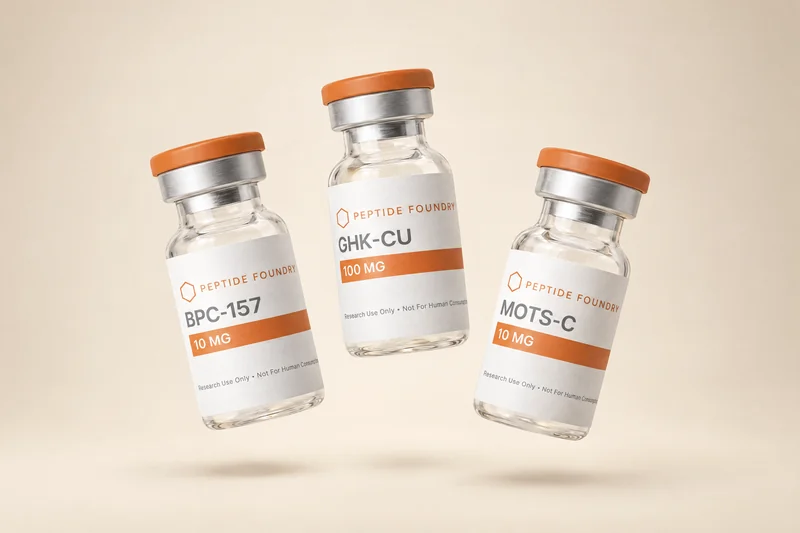
I understand these products are for research use only and not for use in people or pets. I am purchasing these items for laboratory or research purposes only. They are not for human or animal use, not medicine, and not for diagnosing, treating, or curing any condition. I will follow all applicable laws and safe handling rules. I accept that this website, and our affiliates, are not responsible for how I use or store these items once delivered, to the fullest extent allowed by law. In accordance with industry guidelines, access to this website is restricted to individuals 21 years of age or older. This site provides information and products strictly for laboratory and research use.
Lyophilized Peptide Reconstitution: BAC Water vs AA Water (Lab Guide)
Compare AA water and BAC water catalog formulations, additive roles and published lot documentation. Links to current diluent specifications and a BAC report. Research use only.
Last reviewed 29 September 2026 · For research use only
AA water and BAC water differ in their additives and their laboratory roles. Peptide Foundry lists AA water as 0.6% acetic acid in water, an acidic diluent, and bacteriostatic water (BAC) as water with 0.9% benzyl alcohol, a preservative. They are not interchangeable by name: match the diluent specification to the research method, then check the documentation for the material and lot.
Reconstitution means dissolving a lyophilized (freeze-dried) solid to prepare a research solution. This guide compares the two catalog formulations and explains what their published documentation establishes. Volumes, concentrations and solution hold times belong to the laboratory’s validated method. For laboratory research only; not for human or veterinary use.
These are Peptide Foundry’s catalog specifications, checked September 29, 2026. Concentrations and presentations can differ between suppliers; read the actual product label.
Catalog composition describes the listing. A lot report describes the sample tested. Neither a product name nor an available vial size establishes suitability for a particular assay.
What is AA water?
AA water here means acetic acid water. The AA water listing specifies a 0.6% solution. Acetic acid serves as the acidic solvent component; this product is not presented as a preserved multi-use solution.
The AA catalog’s CAS 64-19-7, formula C2H4O2 and molar mass 60.05 g/mol identify the acetic acid component. They do not describe the entire solution as a single pure compound or establish a measured pH for a particular lot.
What is BAC water?
BAC is shorthand for bacteriostatic water. The BAC water listing specifies 0.9% benzyl alcohol as its preservative. Its catalog identity fields—CAS 7732-18-5, H2O and 18.015 g/mol—identify the water component. The additive concentration is a separate specification.
A preservative does not establish compatibility with every research material. Record the required diluent formulation, any additive restrictions and the method’s acceptance criteria before selecting a supply.
Check the lot documentation before comparing test claims
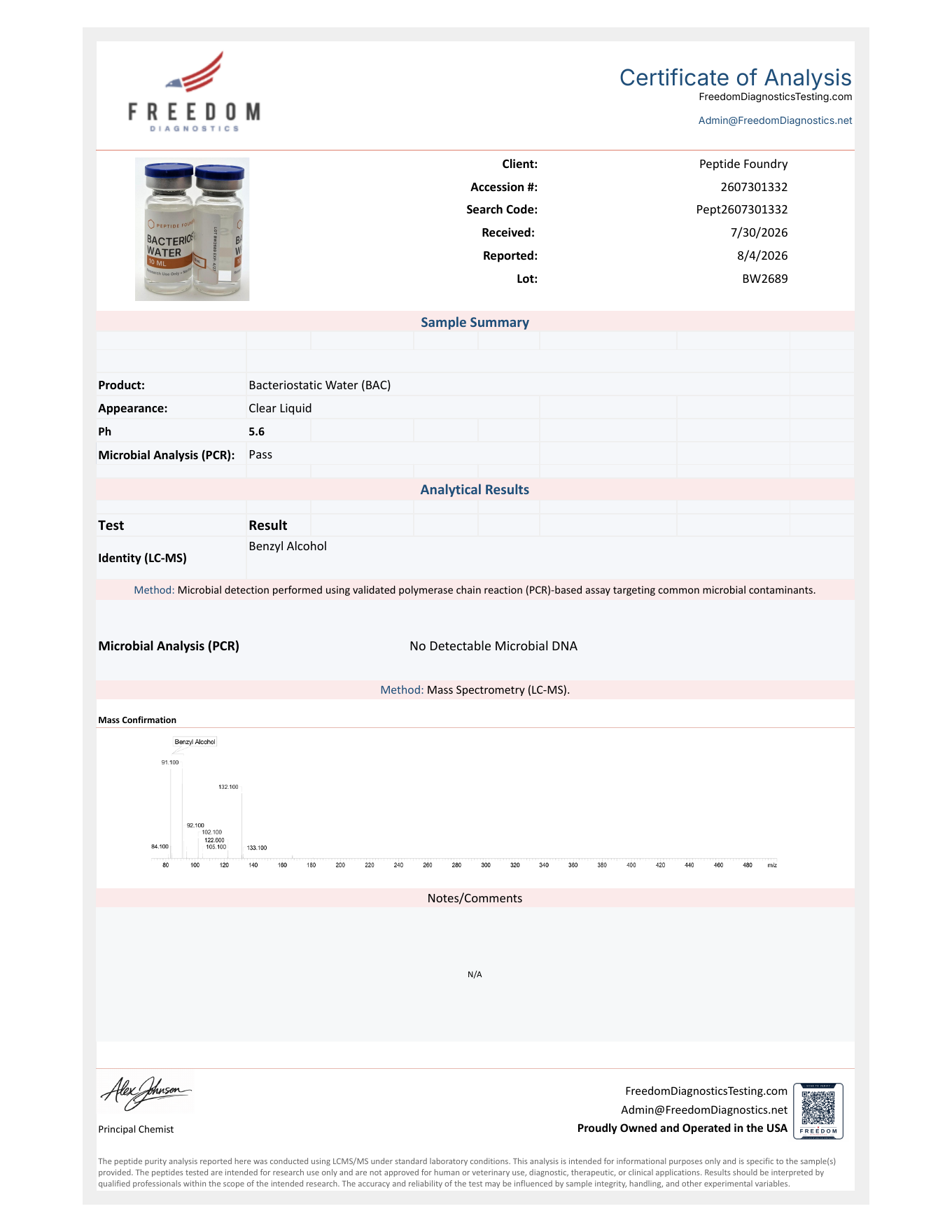
No detectable microbial DNA under the reported PCR microbial analysis.
Those findings apply to the reported sample. A PCR result is not a peptide-purity measurement, a measured benzyl-alcohol concentration, or a universal guarantee for other lots. Match the lot on the vial to the report; do not extend this 10 ml listing’s evidence to a 30 ml vial without matching documentation.
AA documentation
At the September 29 review, the AA product page did not link a public lot PDF. That describes the available public documentation; it does not establish whether other testing exists. For documentation needed by your purchasing process, contact Peptide Foundry with the product name and lot number, and identify the specification or test you need to verify.
For both supplies, retain the product label, lot identifier, report date, laboratory and test method in the research record. The guide to reading a peptide COA explains how identity, content and other test results answer different questions.
Keep diluent storage separate from solution stability
The current AA product instructions specify sealed storage at 15–25 °C, away from direct light, without freezing. They describe AA as unpreserved and direct users to discard unused solution rather than assume a multi-use stability window. Check the current AA storage instructions against the label supplied with your lot.
BAC has its own unopened and post-puncture instructions on the BAC product page. Those instructions apply to that diluent; they do not establish the stability or usable lifetime of a peptide dissolved in it.
Record storage separately for the sealed research material, the diluent and the resulting research solution. Follow the controlling label and validated laboratory procedure for each. If documentation conflicts, resolve it before use rather than choosing a temperature or hold time from an unrelated product.
Common comparison questions
Can AA water replace BAC water?
There is no general substitution rule. The additives serve different roles. Check the research method’s required formulation and compatibility criteria; a clear-looking solution alone does not validate a substitution.
Does the BAC report verify AA water?
No. The linked report names BAC lot BW2689. It is not evidence for AA water or another BAC lot.