

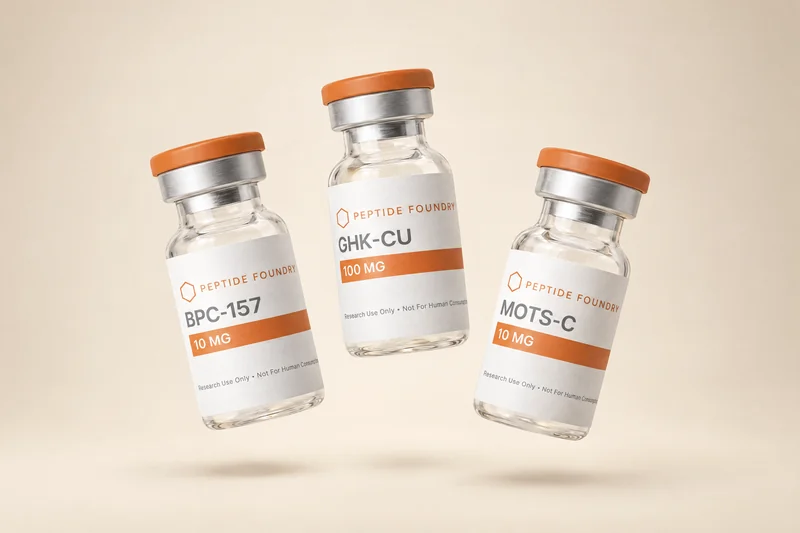
On July 23–24, 2026, FDA’s PCAC reviewed peptide bulk drug substances for the 503A Bulks List. See the public record, why advisory votes are not final listing, and how that differs from RUO research materials. Not legal advice.
Not legal advice. This article summarizes publicly available FDA materials and secondary reporting for researchers who follow peptide-industry developments. It is not legal advice, regulatory counsel, or guidance on compounding, prescribing, importing, or marketing drugs. Peptide Foundry supplies research-use-only (RUO) materials for laboratory use by qualified researchers — not for human or veterinary use. For compliance questions, consult qualified counsel and primary FDA / Federal Register sources.
Key points
- PCAC is advisory; FDA decides list placement through its own process (typically notice-and-comment rulemaking for the codified 503A Bulks List).
- July 23–24, 2026 meeting materials addressed free-base and acetate forms related to BPC-157, KPV, TB-500, MOTS-c, Emideltide, Epitalon, and Semax.
- As of publish-day check (2026-09-11), the codified list at 21 CFR 216.23 still lists a small set of mostly topical substances — no peptides.
- Compounding under 503A/503B is a pharmacy / drug pathway; Peptide Foundry’s catalog is RUO research materials — different intended use.
- Not legal advice — not for human or veterinary use.
This is the first dated Peptide Industry Watch update. It explains what FDA’s Pharmacy Compounding Advisory Committee (PCAC) reviewed for the Section 503A Bulks List in July 2026, why an advisory vote is not a final listing, and how that pathway differs from research-use-only materials. Primary links below; secondary vote narratives are labeled as such.
What is the 503A Bulks List?
Under the Federal Food, Drug, and Cosmetic Act, Section 503A describes conditions under which certain compounded drug products may qualify for exemptions from selected FD&C Act requirements. One piece of that framework is a list of bulk drug substances that may be used in compounding when other statutory and regulatory conditions are met. That list is commonly called the 503A Bulks List.
The codified list lives at 21 CFR 216.23. As verified on publish day 2026-09-11 via eCFR, §216.23(a) lists only:
- Brilliant Blue G
- Cantharidin (topical)
- Diphenylcyclopropenone (topical)
- N-acetyl-D-glucosamine (topical)
- Squaric acid dibutyl ester (topical)
- Thymol iodide (topical)
No peptides appear on that codified list as of that check. Separately, §216.23(d) includes a misbranding warning: presence on the list does not mean a substance is an FDA-approved drug. Listing and drug approval are different concepts — headlines that say “FDA approved peptides for compounding” blur them.
While nominations are reviewed, FDA also maintains interim Category 1 / 2 / 3 evaluations under guidance. Useful primary references:
- Interim Policy on Compounding Using Bulk Drug Substances Under Section 503A (guidance PDF)
- Bulk Drug Substances Nominated for Use in Compounding Under Section 503A (Category lists PDF)
- Category 2 substances that may present significant safety risks (FDA page)
Researchers should re-check eCFR and the current Category PDF rather than treating any single Industry Watch page as a forever snapshot.
What did PCAC review in July 2026?
Meeting logistics (primary)
FDA’s Pharmacy Compounding Advisory Committee met on July 23–24, 2026 under Docket FDA-2025-N-6895. The Federal Register meeting notice is FR Doc. 2026-07361 (published about April 16, 2026). Primary materials:
- Federal Register / GovInfo meeting notice (2026-07361)
- FDA advisory-committee event page
- FDA briefing document
- Meeting agenda PDF
- Draft questions / vote prompts PDF
- BPC-157-related evaluation package (example substance briefing)
FDA briefing packages state that the Agency does not issue a final determination at the advisory meeting. Final determination comes after FDA considers committee input and completes its reviews.
Substances on the agenda
From the FDA agenda and questions PDFs, the committee discussed free-base and acetate forms in these families:
| Substance family | Forms discussed | Session (agenda) |
|---|---|---|
| BPC-157-related | BPC-157 (free base); BPC-157 acetate | July 23, morning |
| KPV-related | KPV (free base); KPV acetate | July 23, morning |
| TB-500-related | TB-500 (free base); TB-500 acetate | July 23, afternoon |
| MOTS-c-related | MOTS-c (free base); MOTS-c acetate | July 23, afternoon |
| Emideltide-related | Emideltide (free base); Emideltide acetate | July 24, morning |
| Epitalon-related | Epitalon (free base); Epitalon acetate | July 24, morning |
| Semax-related | Semax (free base); Semax acetate | July 24, afternoon |
Those names also appear in research-peptide market conversations. Appearance on a compounding advisory agenda is not an endorsement for human use, and it is not a statement about RUO catalog identity. Keep the frames separate.
Advisory vote vs final FDA action
PCAC provides advice to FDA. A committee recommendation is an input — not an automatic amendment to 21 CFR 216.23, not automatic Category 1 placement, and not drug approval.
A durable reading stack for researchers:
- Advisory meeting — PCAC discusses and may vote on questions FDA poses.
- FDA evaluation — the Agency considers committee input and completes its scientific / regulatory review.
- Codified list change — placement on the 503A Bulks List generally proceeds through notice-and-comment rulemaking before 21 CFR 216.23 changes.
- Interim Category lists — while nominations are pending, FDA’s Category PDF and related pages remain part of the public record researchers should re-check.
Secondary reporting on vote outcomes: Until FDA posts official minutes or transcripts, vote tallies should be treated as secondary. Coverage from FDA Law Blog, McDermott, and a BMJ news note describes majority recommendations for six of seven peptide families and not for Emideltide. Prefer FDA-posted minutes/transcript when available; do not treat secondary tallies as the final Agency action.
This page does not predict whether FDA will propose or finalize list changes. Watch the docket, Federal Register, and Category materials instead of meeting headlines alone.
503A vs 503B in one screen
Headlines often mix patient-specific compounding stories with outsourcing-facility stories. A one-screen contrast (literacy only — not a playbook):
| 503A (traditional compounding) | 503B (outsourcing facilities) | |
|---|---|---|
| High-level frame | Patient-specific compounding by pharmacies/physicians under §503A conditions | Registered outsourcing facilities compounding under §503B conditions |
| Bulks lists | 503A Bulks List (codified at 21 CFR 216.23) + interim Category policy | Separate 503B clinical-need / bulks framework |
| What Industry Watch cares about here | July 2026 PCAC peptide nominations for the 503A list | Related-but-different threads (e.g. GLP-1 bulks notices) |
Optional adjacent note (different list): On May 1, 2026, FDA published a Federal Register notice proposing not to include semaglutide, tirzepatide, and liraglutide on the 503B Bulks List (see 91 FR 23431 / Docket FDA-2018-N-3240 thread). FDA has also posted a compounder policy clarification as national GLP-1 supply conditions evolved. That is a related industry thread, not the July 2026 503A peptide PCAC agenda — and not a therapy article.
Compounding pathway vs RUO research materials
Sections 503A and 503B address conditions under which pharmacies and outsourcing facilities may compound drug products for patients. Research-use-only peptide materials are supplied as laboratory research reagents labeled not for human or veterinary use. The frameworks are not interchangeable.
Peptide Foundry’s position on this page: Industry Watch tracks public policy literacy for researchers. We do not advise on compounding eligibility, prescriptions, clinic access, or “workarounds.” Names that appear in compounding dockets may also appear on research catalogs as identity labels; that overlap is a naming fact, not a substitute pathway.
Soft literacy links (quality and claim literacy — not clinical use):
- Peptide Industry Watch hub — series index and dated-update rules
- 503A vs 503B for researchers — evergreen compounding-pathway contrast (not a rewrite of this meeting page)
- USA research-peptide vendor criteria
- How to read a research-peptide COA
- ISO 5 cleanroom walkthrough
- cGMP claim literacy
- Research library index
- Optional identity exemplar: What is the GLOW research blend? (RUO blend identity / COA matching)
What we’re watching next
- Follow-ons under Docket FDA-2025-N-6895 (communications, minutes/transcripts, any related notices).
- Updates to FDA’s interim Category list PDF and Category 2 safety-risks page.
- Any future Federal Register proposed or final rules that would amend 21 CFR 216.23 — without predicting outcomes.
- Category PDF notes that have mentioned further PCAC timing for other nominated substances (for example GHK-Cu notes in FDA materials) — re-verify the current Category PDF; do not treat an old PDF line as a scheduled guarantee.
Later public-record moments will generally ship as new dated Industry Watch children under /research/peptide-industry-watch/ rather than endless silent rewrites of this URL.
Common questions
Did FDA “approve” these peptides as drugs in July 2026?
No. PCAC advice and even a future Bulks List placement are not the same as FDA approval of a drug product. See also 21 CFR 216.23(d)’s misbranding warning about treating list presence as approval.
Did the July 2026 votes make those peptides legal to compound under 503A?
Not by themselves. An advisory recommendation is an input to FDA’s decision-making. Codified list changes generally require FDA’s evaluation and notice-and-comment rulemaking. Check 21 CFR 216.23 and current Category lists rather than treating meeting headlines as final authorization. This is not legal advice.
Can a research vendor’s RUO vial be treated as a compounded drug?
No. Different frameworks and intended uses. Do not conflate RUO research materials with pharmacy compounding under 503A/503B.
Is this page legal advice?
No. It summarizes public materials for literacy. Consult qualified counsel and primary FDA / Federal Register / eCFR sources for compliance questions.
Are Peptide Foundry materials for human use?
No. Research use only — not for human or veterinary use.
Where should I go for the series index?
The hub at /research/peptide-industry-watch/ explains scope, how dated updates work, and lists children.
Return to the series home: Peptide Industry Watch.
Not legal advice. This Industry Watch update is informational content for researchers. It does not constitute legal, regulatory, compounding, prescribing, or import guidance.
Research use only. Nothing on this page describes or implies use in humans or animals. Peptide Foundry materials are supplied for in-vitro and laboratory research by qualified researchers and for no other purpose. Substances named in compounding dockets are discussed here for public-record literacy only — not as clinical recommendations.